This project started back in 2022, when I built air quality monitors connected to Home Assistant: small devices running on solar panels and batteries.
The idea behind them was bigger than air quality. Sensors like these could watch a greenhouse and act on it, track the weather, or monitor pretty much anything you care about. What really interested me was applying that to beekeeping and farming. In 2025 I took a step in that direction, monitoring my plants over LoRa, a long-range radio, with a valve for watering. Then both projects sat there.
This month I picked it all back up, with a bigger goal. Instead of a pile of integrations around Home Assistant, it’s becoming a standalone system that works on its own. It’s called thetalink for now. That’s a codename, not the final name.

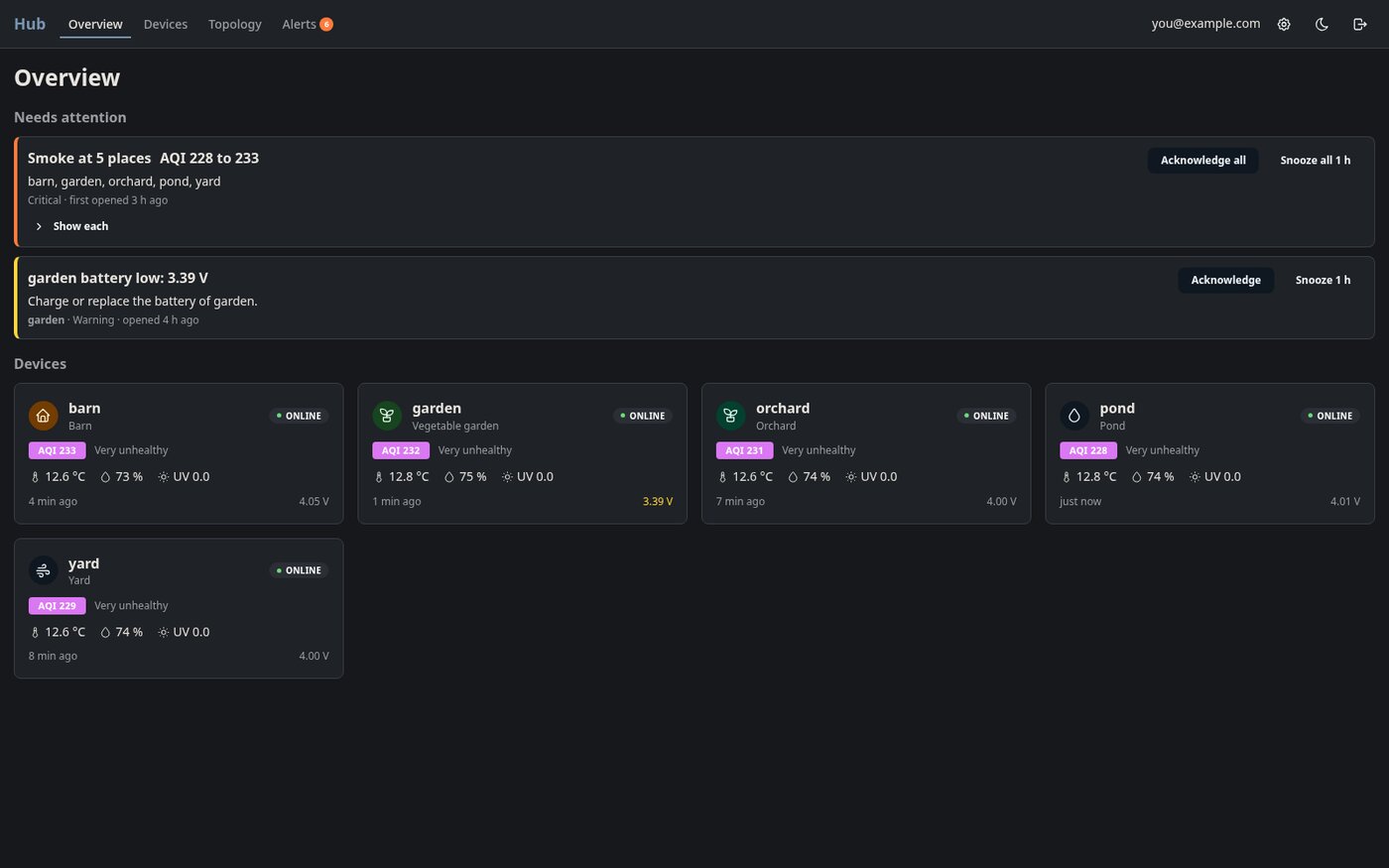
The hub’s overview: what needs attention first, then every sensor at a glance. This is simulated data, during a smoke event.
What it is
thetalink is a long-range sensing and automation platform for properties bigger than a backyard: a big garden, a homestead, a small farm.
It has two parts:
- A hub: a small box with a LoRaWAN gateway and all the software, running on site.
- Sensor and actuator nodes: battery-powered devices spread across the property, talking to the hub over LoRa, which reaches much further than Wi-Fi.
The idea that drives everything: far-reaching senses, local brain. Monitoring, alerts and automation all run on the hub, with no internet needed. A cloud option for remote access and backups may come later, but nothing depends on it.
Why not just buy something?
When I looked at what exists, I found a gap:
- Consumer gadgets are cheap, but they reach about a hundred meters, limit how many sensors you can add, and keep the smart features in the vendor’s cloud.
- Commercial agricultural systems have the range, but they’re priced and built for large farms, and they’re cloud-first too.
- Do-it-yourself LoRa works, but it takes radio, firmware and server skills, and what you get at the end is graphs, not answers.
What I want is the last part done differently: not graphs, but answers. “Frost tonight in the lower field.” “Smoke outside, close the windows.” “Zone 2 needs water.”
Where it is now
So far that means the core of the system, and one real sensor to go with it.
The first node is an air quality sensor: temperature, humidity, UV and fine particles. Air quality is a good test of the “answers, not graphs” idea. The hub doesn’t just show raw particle counts. It corrects them and turns them into an air quality index you can act on, and when smoke shows up at several sensors at once, you get one alert that says “smoke at 5 places”, not five separate ones.
The hub software already does the basics properly:
- Alerts that can be acknowledged or snoozed, that reopen if things get worse, and that show the readings behind them.
- Device health: battery, signal, and sensors that seem stuck.
- Notifications to my phone.
- A topology view that shows which gateway hears which sensor, and how well.
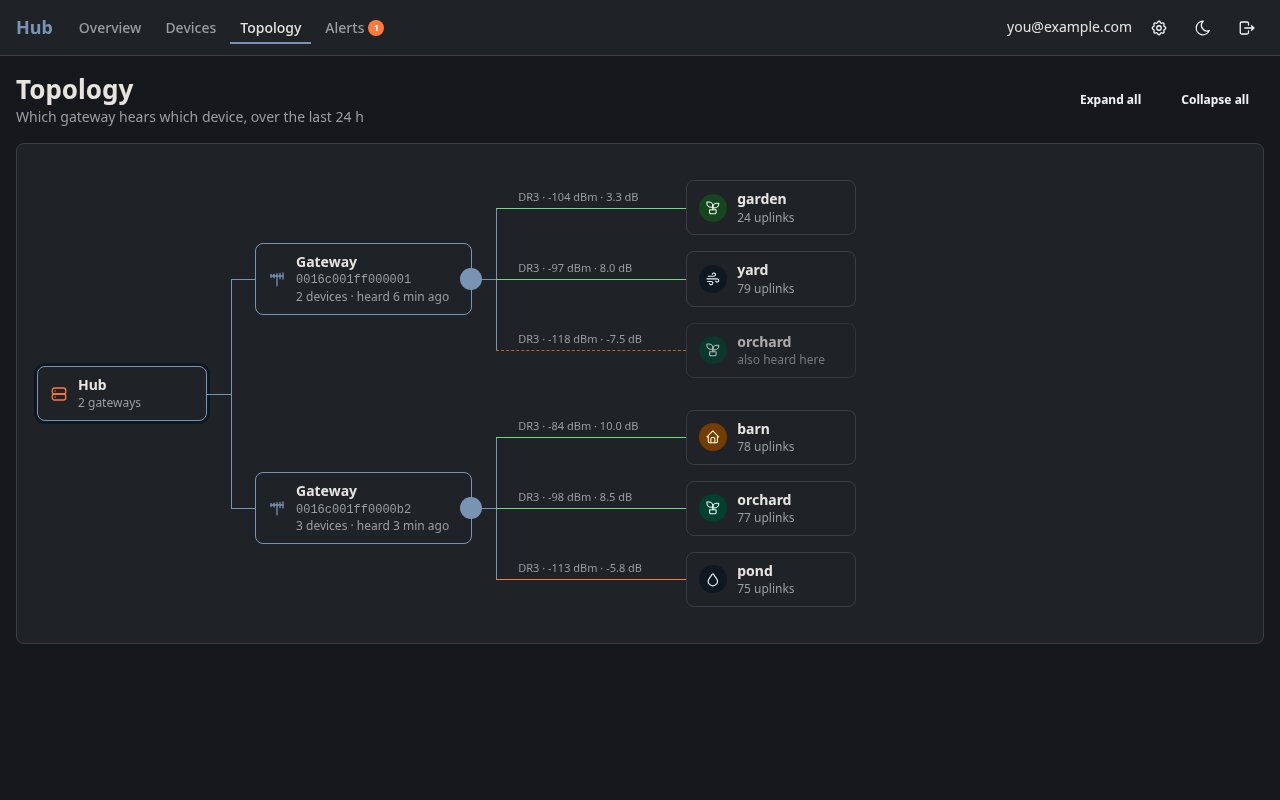
The topology view: which gateway hears each sensor, and how strong the signal is. The orchard sensor is heard by both gateways.
There’s also a simulator that can play out scenarios (a smoke event, a dying battery, a sensor going quiet) against the real software, so I can build and test the whole thing before every piece of hardware exists. Every screenshot in this post comes from it.
How it’s built
The hub is the same shape as my other projects: a single Rust binary with a web interface built in, and a standard open-source LoRaWAN network server alongside it rather than writing my own.
It’s also meant to be open: the hub software, the firmware, the radio protocol and the hardware designs each have an open license. Anyone should be able to bring their own sensors, or build their own.
What’s next
The next step is hardware in the real world. Parts for an outdoor test node are ordered, built into an off-the-shelf box with a proper shield so the temperature reading isn’t cooked by the sun. The plan is to leave it outside through the winter and see what breaks.
After that: soil moisture, tank levels, frost alerts, and eventually closing the loop with watering, which is where this whole project started.
It’s early, so the repository is private for now. It’ll be public once there’s something worth running.