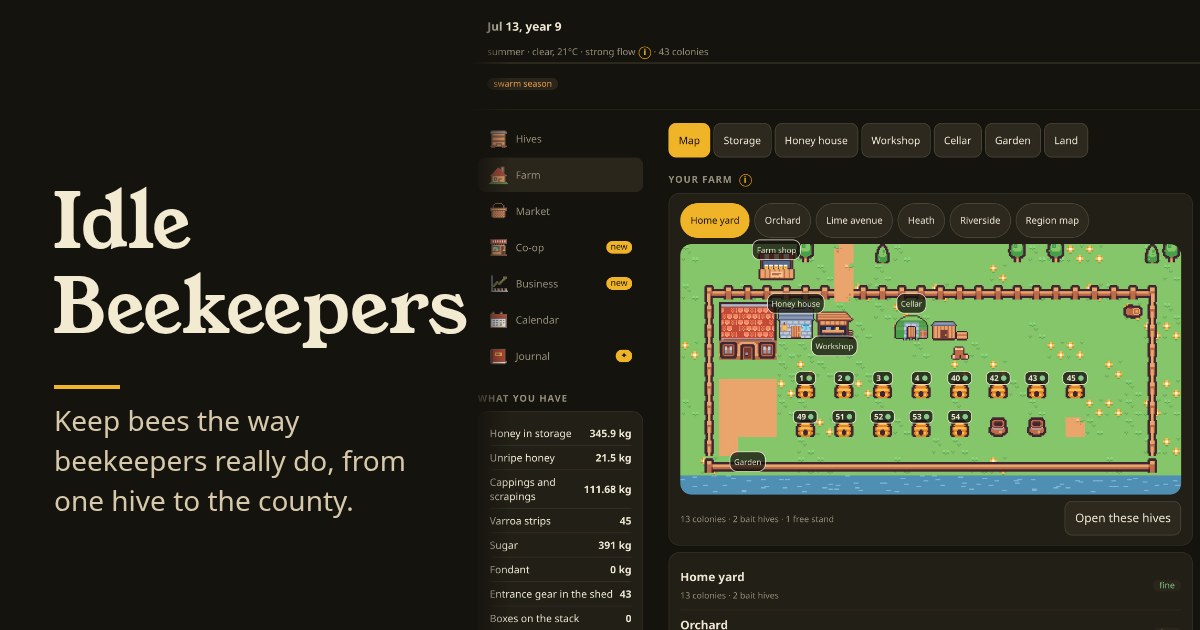
Idle Beekeepers is a slow idle game about keeping bees the way beekeepers really do. It plays in your browser and installs like an app.

Year 9: forty colonies, a honey house, a workshop and a cellar.
The premise
You’re a burnt-out office worker. One day a parcel arrives: a second-hand beekeeping book from your aunt. No letter, just a line on the flyleaf: “You always did like a system you could watch work.”
You read it for a year. Then you quit your job and buy a run-down farm at the end of a lane, with one overwintered colony and a few jars of last year’s honey.
From there it’s twenty-odd years of seasons. One hive becomes a few, then a real apiary with out-yards, staff, a honey house, a workshop, candles and mead, a brand, contracts. Near the end, money stops being the point, and you’re paying for hedgerows across the county, a bee school, and a foundation that keeps the county’s bees healthy after you. Then one Tuesday at the co-op, someone is standing at the counter looking the way you did. You give them the book.
Real beekeeping, as the rule
The design rule was simple: when in doubt, follow real life.
- Colonies die of mites, starvation, queen failure or robbing, at rates based on real winter-loss surveys. A careful keeper loses roughly one colony in eight over winter. Neglect loses most of them.
- You only know what you saw. A hive tells you nothing until you open it, and you can only open it on a warm, dry day. The rest of the time you heft the box to feel its weight and watch the entrance. Every hive card says when you last looked: “seen 2 days ago, it may have changed”.
- Mite treatment is a course over weeks, not an instant fix, and swarms come in late spring, like the real thing.
- Every book in the game is real beekeeping, chapter by chapter. Reading one is how new work opens up. The same books are published as a wiki.
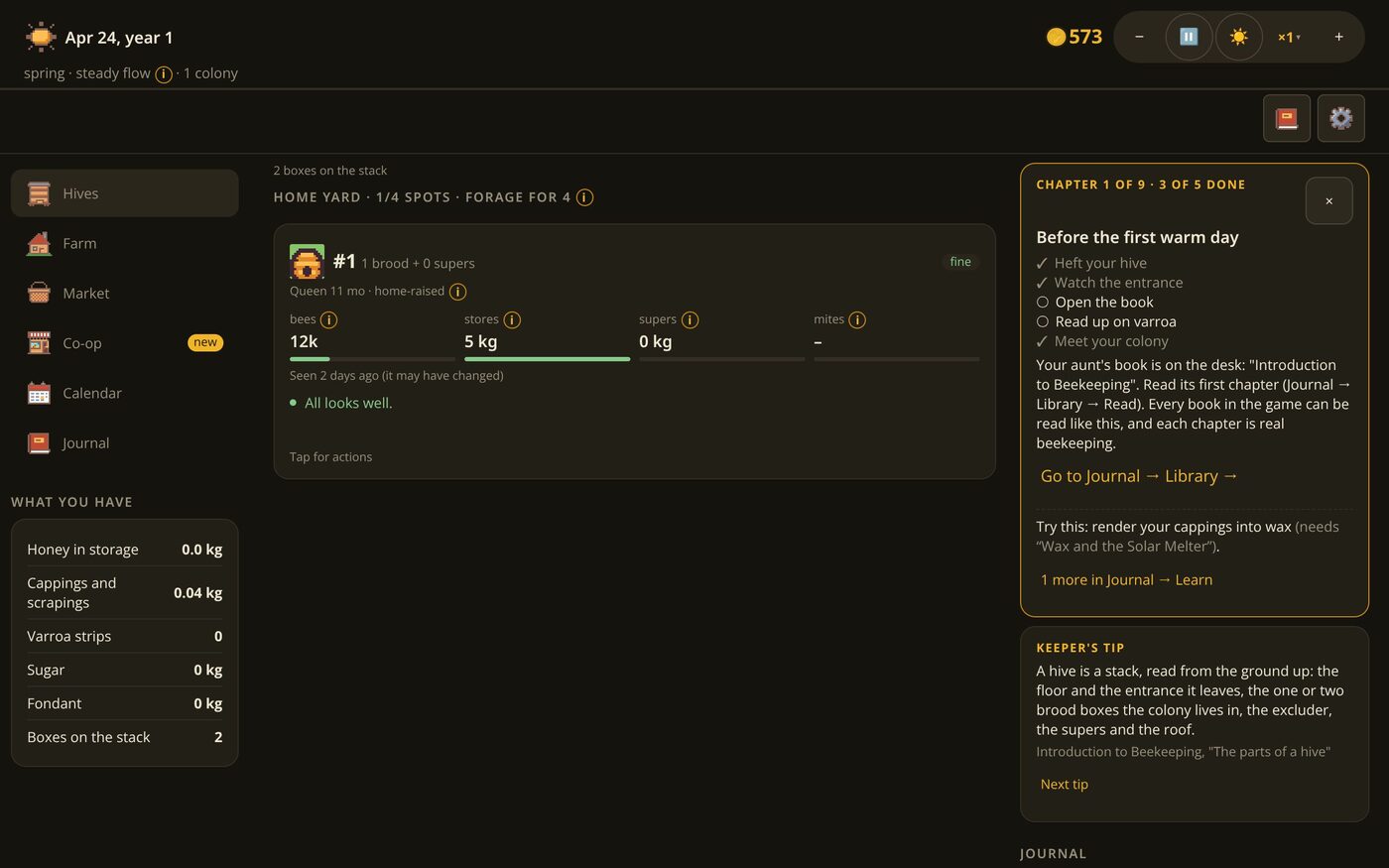
Year 1, spring. One colony, and a list of things to do before the first warm day.
Idle, but slow
It’s an idle game in the Universal Paperclips sense: numbers matter, graphics don’t, and the interface has to be excellent. But the pace is the seasons, not a clicker.
You don’t buy robots. You hire people. Each hire takes over a job, does it less carefully than you would, and costs a wage. Throughput goes up, precision goes down. Staff also speed up the calendar, so the game gets faster as the farm grows.
Time is computed from the real clock, not from ticks, so closing the tab and coming back lands you on exactly the right day with exactly what would have happened. Pausing really pauses, even while the game is closed. And there’s a button for “pause until the next warm day”, because that’s what beekeeping mostly is.
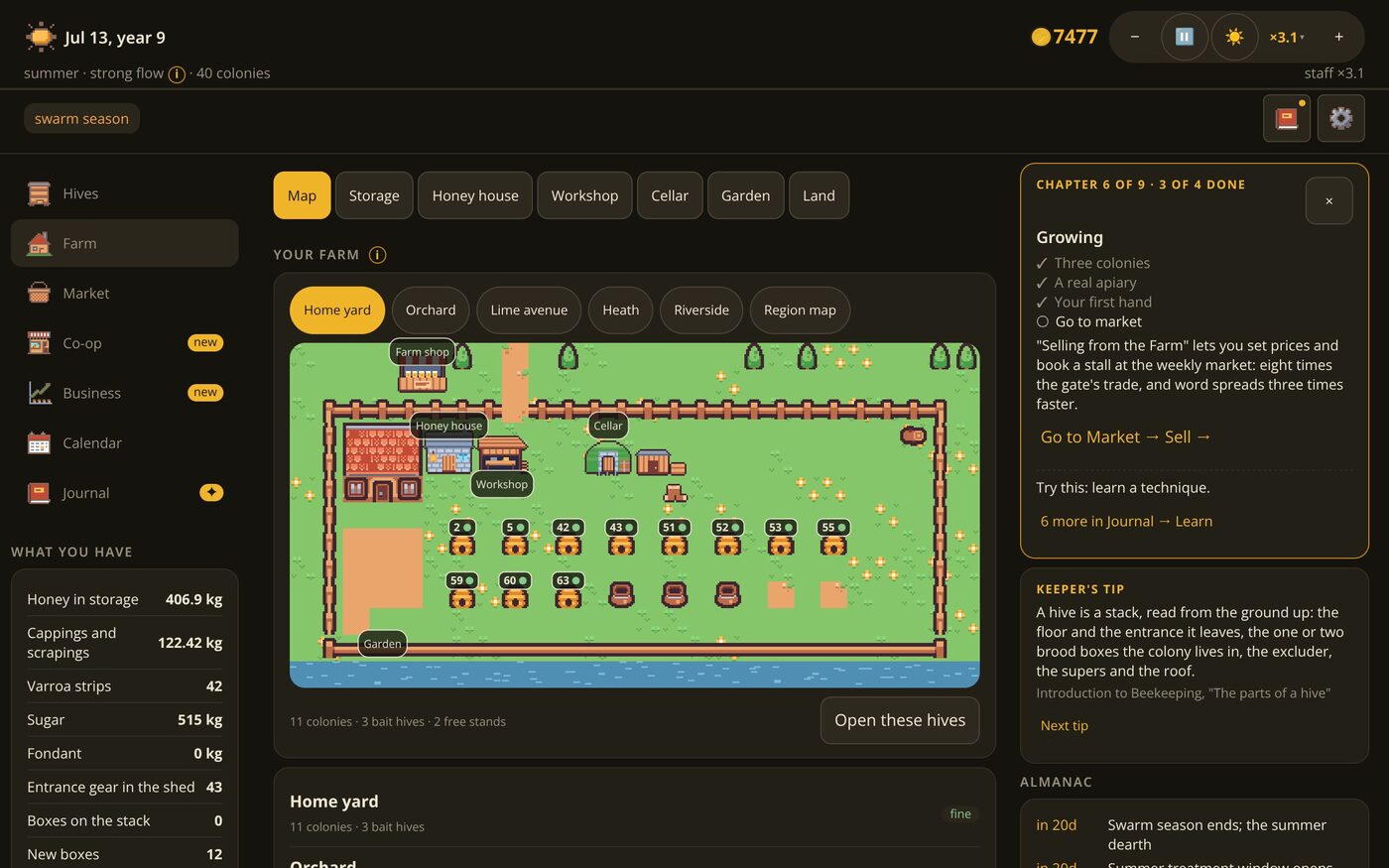
The home yard in year 9. Each hive has a status dot: green is fine, amber needs checking, red needs you. Tiles are Kenney’s Tiny Town (CC0).
Winter is the reckoning. You count what survived, and what you learned carries over into the next year as techniques and stock genetics. Losing colonies costs you time, never permanent progress.
Tom
The first version assumed players would figure things out the way idle-game players do. They didn’t. New players didn’t know what to do first, or why they’d want a book about mites.
So the game got a mentor: Tom, the old farmer down the lane who sold your aunt her first colony. Gruff, kind, few words. He walks you through your first week, then drops by during your first year whenever something happens for the first time: the first mites, the first swarm, the first harvest, the first winter.
The last release brings him back the spring after. He reacts to how your winter went (everything survived, some did, nothing did), points you towards splitting your colonies, and says goodbye.
How it was built
It’s TypeScript and React, with the game rules kept completely separate from the interface. That separation made the most useful thing possible: bots play the game. A handful of playtest bots, from careful to neglectful, play thousands of farms over many in-game years without a browser. Balance changes are judged on what happens to those farms, not on how a change feels in one playthrough, and a check fails if the balance drifts without anyone deciding it should.
The same bots also make the marketing. The build plays farms to five stages of a career, takes screenshots, and builds the front page from them. The screenshots in this post come from there.
The game also has a full French translation, and every old save still loads in the latest version.
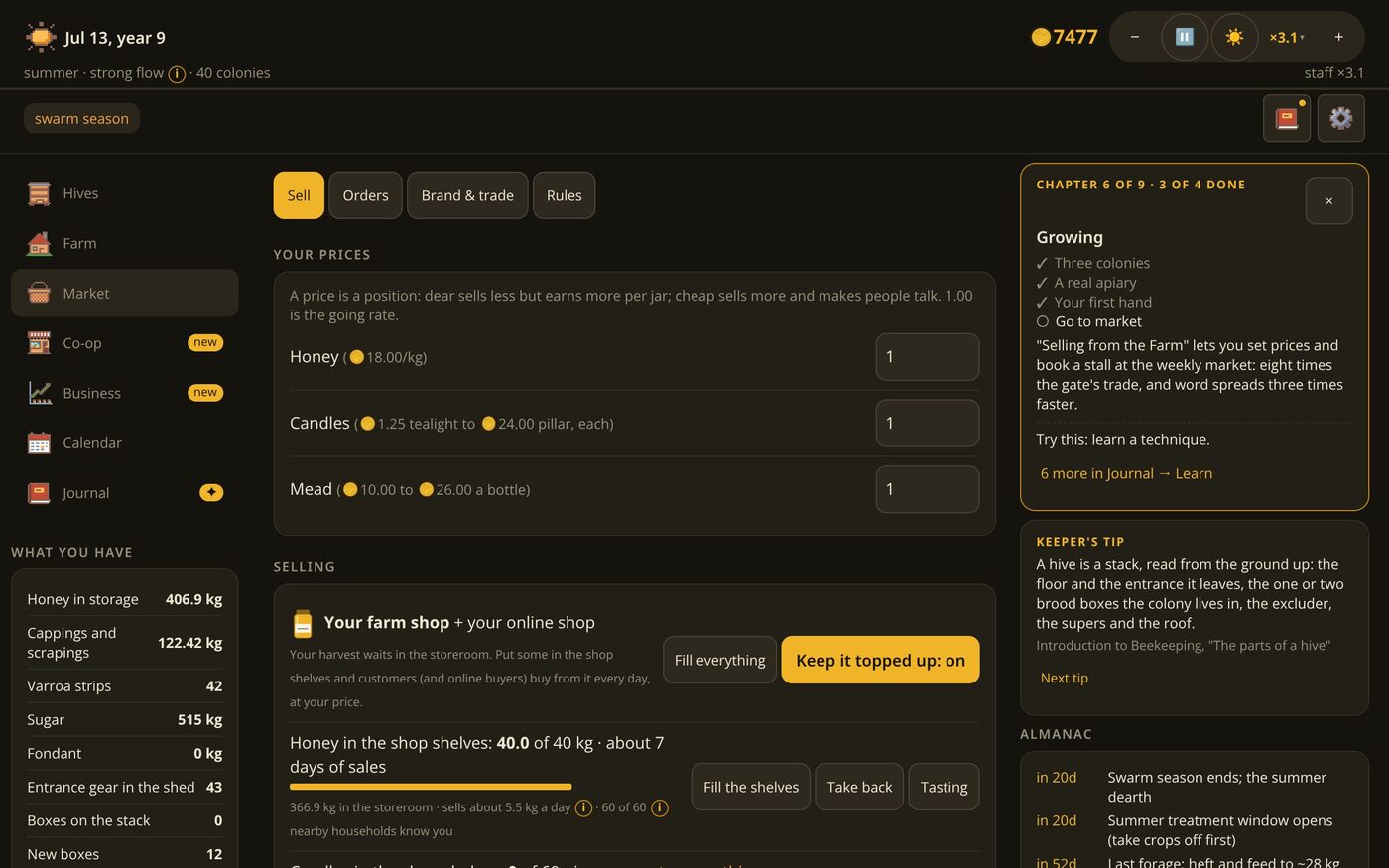
Selling: set prices, fill the farm shop, take orders.
Where it stands
It’s at v0.52.0. I’m happy with where it is, and I’m leaving it there for now.
Idle Beekeepers is a spin-off. It started as a quick experiment set in the world of a bigger beekeeping game I’ve been building in Godot, with its numbers borrowed from that game’s balance data. That one’s a different kind of game, and it gets its own post.
Play it in your browser. Your farm is saved on your device.